Heat-up Tea
Heat-up Tea
Imitation learning enables robots to acquire complex skills from demonstrations, but performance often degrades when tasks span large environments or long time horizons. A core challenge is partial observability: onboard sensors rarely capture the full scene at once.
We propose using task-relevant scene graphs as an explicit, structured memory for imitation learning. Each object is represented as a node with visual embeddings, 2D bounding boxes when visible, and persistent 3D centroids when out of view. This compact representation lets a diffusion policy reason over spatial and temporal context accumulated throughout an episode.
Experiments on simulated mobile manipulation with Boston Dynamics Spot and real-world tabletop manipulation with a Franka arm show substantial gains over RGB and object-centric baselines, especially on long-horizon tasks that require remembering objects outside the current field of view.
Our pipeline builds and updates a task-driven scene graph online, then conditions a transformer-based diffusion policy on the resulting node sequence.
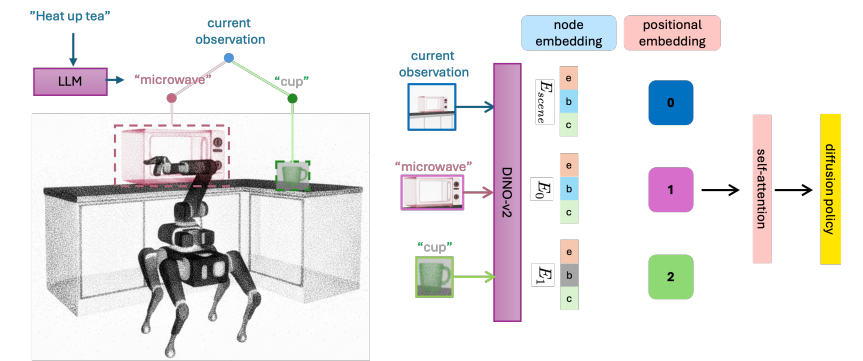
Given a natural-language task description, an LLM extracts a list of relevant object nouns (e.g., microwave, cup for “heat up tea”).
Grounding DINO detects task-relevant objects in the first frame. Each node stores a DINO-v2 embedding, 2D bounding box, and 3D centroid from depth backprojection. XMem tracking preserves identity over time; new detections are merged when they do not overlap existing nodes.
Nodes are encoded with MLPs over geometry and processed by a transformer encoder together with a scene-level root token. The resulting representation conditions a diffusion policy (DDPM training, DDIM inference) that outputs short-horizon action sequences.

Rollout videos from simulated Spot experiments and real-world Franka tabletop manipulation.
Heat-up Tea
Heat-up Tea Long
Pineapple-Bowl
Feed-Animals
Feed-Giraffe
Clean-Table